
Kennedy Expressway Truck Crashes: Lane Changes, Reversible Lanes and Freight Traffic on I-90/94
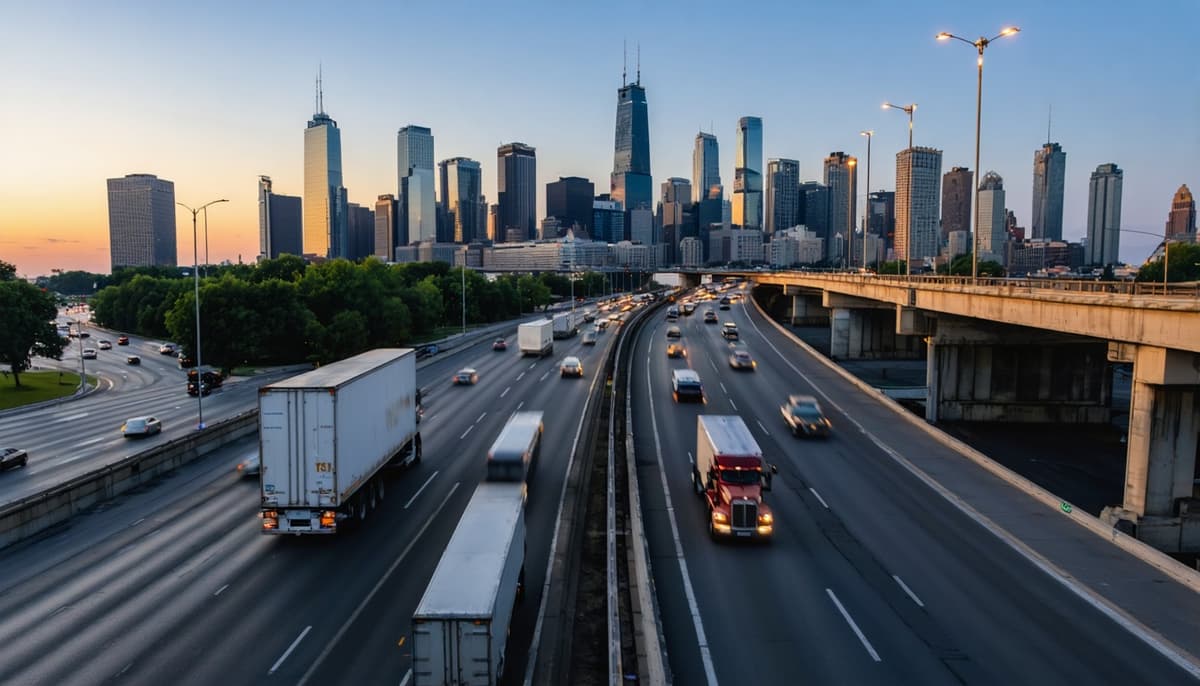
The Kennedy Expressway carries O'Hare-bound freight through reversible express lanes, short merges and dense commuter traffic on I-90/94. This guide explains how truck crashes happen there and which federal and Illinois rules decide fault.
Available 24/7 · No fee unless we win · Licensed in Illinois
Who can be held liable for a truck crash on the Kennedy Expressway?
The truck driver, the motor carrier, a shipper or loader, and a maintenance vendor may each share liability, depending on what the lane-change evidence, hours-of-service logs and inspection records show.
Overview
Hit by a semi-truck on the Kennedy Expressway? The weeks after a crash on I-90/94 can feel overwhelming, and our Chicago truck accident lawyers are here to help you understand what happened and what you may be owed.
We understand that a collision with a tractor-trailer can be a catastrophic and traumatic event — for you, for your family, and for everyone who depends on you. If you or a loved one were injured in a Kennedy Expressway truck crash that you did not cause, you may be entitled to compensation for medical bills, lost wages, and pain and suffering.
This guide explains how the Kennedy's reversible express lanes, short merge points and heavy freight traffic create crash risk. It also covers how the Federal Motor Carrier Safety Regulations (FMCSR) and electronic logging device (ELD) data come into Illinois claims that arise on this corridor, and where it fits within our broader coverage of Chicago truck accident corridors.
How Freight Moves Through The Kennedy Corridor
The Kennedy Expressway runs northwest from the Jane Byrne Interchange near downtown toward O'Hare International Airport. For the stretch between downtown and the junction with the Edens Expressway on the Northwest Side, I-90 and I-94 share the same pavement, after which I-94 splits north and I-90 continues toward the airport and the Jane Addams Memorial Tollway.
That geometry matters for truck traffic. A tractor-trailer heading to an air-cargo facility near O'Hare, a distribution center in the northwest suburbs, or a rail yard on the city's west side may all funnel through the same lanes as commuters, rideshare drivers and airport travelers.
Some of the freight movements that commonly share the Kennedy include but are not limited to:
- Air-cargo drayage. Trucks moving freight between O'Hare-area cargo facilities and warehouses across the region often rely on I-90 and the I-190 airport spur. These short, repeated runs can push a driver through dense traffic many times in a single shift.
- Regional distribution. Box trucks and tractor-trailers serving retail, grocery and restaurant accounts on the North and Northwest Sides use the Kennedy to move between downtown and suburban hubs.
- Intermodal and container traffic. Chassis-mounted containers moving between rail ramps and customers add long, heavy loads to an already crowded corridor — a topic we cover in more depth in our guide to intermodal chassis crashes.
- Through traffic. Long-haul carriers connecting to the Edens, the tollway system or the Dan Ryan may use the Kennedy as a link rather than a destination.
All of these trucks share the same physical limits. A loaded tractor-trailer needs far more distance to stop than a passenger car, has large blind spots along both sides, and cannot change lanes as quickly when traffic suddenly compresses.
What's more, the Kennedy has been the site of a multi-year rehabilitation project that the Illinois Department of Transportation (IDOT) began in 2023. Construction staging, temporary lane shifts and closures can change where merges happen from one month to the next, and the conditions on the day of your crash may need to be reconstructed from IDOT records rather than assumed from today's layout.
Reversible Express Lanes And Merge Points
One feature sets the Kennedy apart from most Chicago expressways: the reversible express lanes. These lanes run in the median between the area near downtown and the Edens junction, and IDOT switches their direction to match peak demand — generally inbound toward downtown in the morning and outbound later in the day.
The reversible lanes can move traffic efficiently, but every entrance and exit point is a place where vehicles traveling at different speeds must sort themselves out. For a truck driver, that sorting often means a lane change across one or more lanes of traffic within a short distance.
Several design and traffic conditions on the Kennedy can raise the risk of a truck crash, such as:
- Short merge and weave zones. Where express-lane traffic rejoins the local lanes, or where on-ramps feed traffic in close to off-ramps, drivers must enter and exit within a limited stretch of pavement. A long trailer occupies more of that space and takes longer to complete the maneuver.
- Speed differentials. Express-lane traffic may be moving freely while the local lanes are stopped, or the reverse. When those two streams merge, a truck that cannot slow down in time can rear-end slower vehicles or force a sideswipe.
- Confined sections with limited shoulder. Stretches near downtown, including the covered section commonly known as Hubbard's Cave, leave little room to escape a sudden lane change. Reduced lighting and limited shoulders can also complicate how a driver reacts.
- Lane-direction transitions. During the window when IDOT changes the direction of the reversible lanes, gates and signs control access. A driver who misreads or ignores those controls may end up making an abrupt correction near an entrance.
- Stop-and-go congestion. Repeated compression waves on a congested corridor create rear-end exposure. Our guides to jackknife truck crashes and underride crashes explain why a sudden stop can be so dangerous when a truck is involved.
Keep in mind that a difficult road layout does not excuse a professional driver. Commercial drivers are trained and licensed to anticipate merges, manage following distance and plan lane changes well before an exit.
That said, road design and signage may still be part of the investigation. If the evidence suggests that a work-zone layout, gate failure or signage problem contributed to the crash, a claim involving a state agency follows separate Illinois Court of Claims procedures with their own notice deadlines, so it is important to identify every potentially responsible party early.
Lane Changes, Blind Spots And The Rules That Govern Them
Many Kennedy Expressway truck crashes begin with a lane change. A truck moves left to reach the express lanes or right to reach an exit, and a passenger vehicle in the trailer's blind spot is struck, pushed into another lane or forced into the barrier.
Illinois law sets clear expectations for these movements. Under the Illinois Vehicle Code, 625 ILCS 5/11-709, a driver on a roadway divided into lanes must stay as nearly as practicable within a single lane and may not move from that lane until first ascertaining that the movement can be made with safety.
Other rules often come into a Kennedy lane-change claim, including:
- Signaling. Under 625 ILCS 5/11-804, drivers must signal before changing lanes, with a continuous signal for a set distance before the move. A truck that drifts or cuts over without signaling gives surrounding drivers no warning.
- Following distance. Under 625 ILCS 5/11-710, drivers may not follow another vehicle more closely than is reasonable and prudent given speed and traffic. On a congested corridor, a truck tailgating through a merge zone leaves no margin for error.
- Federal compliance with local law. Under 49 CFR 392.2, every commercial motor vehicle must be operated in accordance with the laws of the jurisdiction where it is being driven. A violation of the Illinois Vehicle Code can therefore also become a federal compliance issue.
- Mirrors and equipment. Under 49 CFR Part 393, trucks must carry required equipment, including rear-vision mirrors addressed in 49 CFR 393.80. A missing, damaged or misadjusted mirror can be part of a blind-spot claim.
Blind spots — often called no-zones — run along both sides of a tractor-trailer, directly behind the trailer and directly in front of the cab. The right side blind spot is especially large, which is why a truck moving right toward an exit ramp can strike a vehicle the driver never saw.
Of course, "I did not see the car" is not a defense when the driver had a duty to check before moving. Distraction is a frequent factor in these crashes, and federal rules restrict texting and hand-held phone use under 49 CFR 392.80 and 392.82, which we explain in our guide to trucker phone violations.
Remember that the trucking company may argue that you were the one who changed lanes unsafely. Illinois follows a modified comparative fault rule under 735 ILCS 5/2-1116, which means your share of fault, if any, reduces your recovery — and that is why independent evidence of who moved first, who signaled and where each vehicle was positioned matters so much.
How FMCSR Rules And ELD Data Come Into Kennedy Claims
A lane-change crash is rarely just about the moment of impact. In many cases, the more important question is why a professional driver made the decision they did — and federal trucking records often help answer it.
The Federal Motor Carrier Safety Regulations govern interstate carriers and their drivers. Several parts come up again and again in Kennedy Expressway claims.
Hours Of Service Under 49 CFR Part 395
Under 49 CFR 395.3, a property-carrying driver generally may drive no more than 11 hours after 10 consecutive hours off duty, may not drive beyond the 14th hour after coming on duty, and must take a 30-minute break after 8 cumulative hours of driving. A driver who is behind schedule after hours of airport and city traffic may feel pressure to force a merge rather than miss an exit.
Fatigue slows reaction time and degrades judgment in exactly the kind of dense, fast-changing traffic the Kennedy produces. Our guide to driver fatigue crashes covers how fatigue is proven and why it is often underreported at the scene.
What ELD Data Can Show
Most interstate drivers who must keep records of duty status use an electronic logging device under 49 CFR Part 395, Subpart B. The data elements an ELD records are set out in 49 CFR 395.26 and include duty-status changes, date and time, engine hours, vehicle miles and location information.
Here is how ELD data can fit into a Kennedy claim:
- Hours-of-service compliance. The log can show whether the driver was within their driving and on-duty limits at the time of the crash.
- Trip reconstruction. Location and mileage entries can help place the truck along the corridor and show where the driver came from and how long they had been driving.
- Edits and annotations. ELD records track edits, so changes made after the fact can become evidence in their own right.
- Cross-checks against other records. Fuel receipts, toll records, dispatch messages and delivery documents can confirm or contradict what the log says.
Note that an ELD is not the only data source on a modern truck. The engine control module, onboard cameras and telematics systems may record speed, braking and following distance, which we discuss in our guide to truck speed limiter data.
Be aware that not every truck on the Kennedy is required to run an ELD. Drivers operating under the short-haul exception in 49 CFR 395.1(e) — common for local drayage around O'Hare — may instead keep time records, so the evidence plan has to match the type of operation involved.
Driver Qualification, Inspection And Testing Records
Beyond logs, the carrier's own files can show whether the driver should have been behind the wheel at all. Under 49 CFR Part 391, carriers must maintain a driver qualification file, and our guide to driver qualification files explains what those files contain and why they matter.
Inspection records under 49 CFR Part 396, including driver vehicle inspection reports, can reveal brake, tire or mirror defects. In addition, post-accident drug and alcohol testing under 49 CFR 382.303 may be required depending on the severity of the crash and whether the driver was cited.
Why Preservation Has To Happen Fast
Under 49 CFR 395.8(k), carriers must keep records of duty status and supporting documents for six months. Electronic data from cameras and telematics systems can be overwritten even sooner, depending on how the carrier's systems are configured.
This is why we send preservation demands as early as possible after a Kennedy Expressway truck crash. Our guide to ELD data preservation in Chicago walks through that process step by step.
What Steps Should I Take After A Kennedy Expressway Truck Crash?
The hours and days after a truck crash can be chaotic, particularly if you are dealing with injuries or a hospital stay. Your health comes first, and nothing about a legal claim should come before getting the medical care you need.
When you are able, here is a list of the steps that can help protect your claim:
- Get medical care and keep the records. Some injuries, including concussions and other truck crash brain injuries, may not show symptoms right away. Follow-up visits create a record that connects your injuries to the crash.
- Request the crash report. Crashes on the Kennedy are typically handled by the Illinois State Police, and the report may identify the carrier, the truck's USDOT number and any citations issued.
- Preserve your own evidence. Photos of the vehicles, the lane position, signage and the reversible-lane gates can help, as can dashcam footage and the names of witnesses.
- Write down what you remember. Note which lane each vehicle was in, whether the truck signaled, and whether traffic was merging from the express lanes or a ramp.
- Be careful with insurance calls. The carrier's insurer may contact you quickly, and recorded statements can be used to shift fault toward you.
- Talk to a truck accident attorney early. Early involvement gives the best chance of preserving ELD data, camera footage and maintenance records before they are lost.
Our guide to the first 72 hours after a semi crash explains each of these steps in more detail. If you were hurt on another Chicago corridor, our guides to Stevenson Expressway truck crashes and Tri-State Tollway crashes cover the conditions specific to those roads.
Timing also matters for the claim itself. Most Illinois personal injury claims must be filed within two years under 735 ILCS 5/13-202, and questions about value and timing are covered in our guides to Illinois truck accident settlement value and the Chicago settlement timeline.
Our Truck Accident Lawyers Are Here To Help
A truck crash on the Kennedy Expressway can change your life in a split second, leaving you with medical bills, time away from work and injuries that affect your family for years. While nothing can undo what happened, we also know that you may be entitled to compensation, and we are here to help.
Our attorneys focus on truck accident claims in Chicago and throughout Illinois. We work to preserve ELD and telematics data early, review driver qualification and inspection records, and reconstruct how the lane change or merge actually unfolded on the day of the crash.
Do you think a truck driver's lane change, fatigue or distraction caused your crash on I-90/94? We welcome the opportunity to speak with you about your situation and help you determine the next steps.
Free consultation. No fee unless we recover — you will not pay lawyer's fees unless we recover compensation for you.
This article is for informational purposes and does not constitute legal advice. Consult a qualified attorney in your jurisdiction about your specific situation.
Frequently Asked Questions
Most Illinois personal injury claims must be filed within two years under 735 ILCS 5/13-202, and wrongful death claims generally follow a two-year limit under 740 ILCS 180/2. Exceptions exist, so confirm your deadline early.
Often, yes. Illinois uses modified comparative fault under 735 ILCS 5/2-1116, so your recovery is reduced by your share of fault and barred only if you are found more than 50% responsible for the crash.
Under 49 CFR 395.8(k), carriers must keep records of duty status and supporting documents for six months. That window can close before a claim is filed, which is why a preservation letter should go out quickly.
No special fault rule applies. The same Illinois lane-usage and signaling statutes govern, but if a claim involves a state agency's lanes, gates or signage, separate Court of Claims procedures and shorter notice deadlines may apply.
Under 49 CFR 382.303, testing is required after a fatal crash, or when the driver is cited and someone needs treatment away from the scene or a vehicle is towed. Alcohol tests run within 8 hours and drug tests within 32 hours.
Keep exploring the library.
Get your free case evaluation today
Were you or a loved one injured in a crash involving a commercial truck in the Chicago area? Get a free, confidential case evaluation.

Find Us
Chicago Truck Accident Lawyers1132 S Wabash Ave, Suite 303
Chicago, IL 60605-2305
Call 24/7312.728.2989
Get Directions