
Stevenson Expressway Truck Crashes: Why I-55 Between Chicago and Joliet Carries So Much Freight Risk
I-55 connects downtown Chicago with the warehouse and intermodal belt around Bolingbrook, Romeoville, Joliet and Elwood. Its interchanges, work zones and commuter congestion put tractor-trailers and passenger vehicles in tight quarters every day.
Available 24/7 · No fee unless we win · Licensed in Illinois
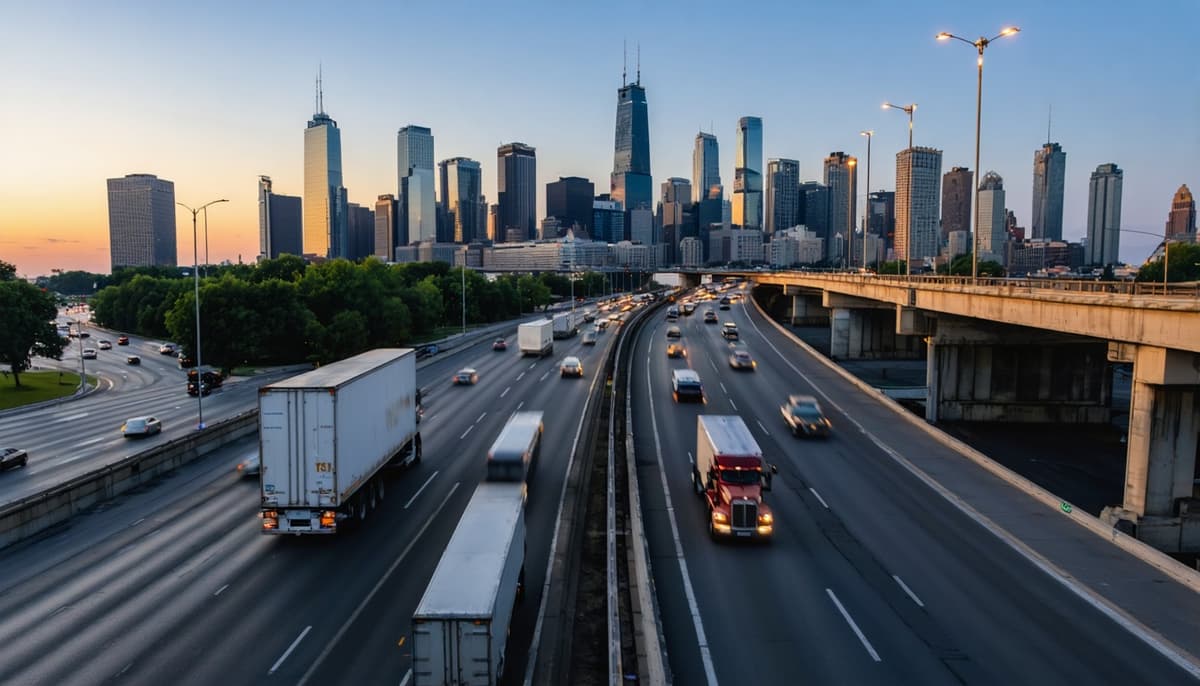
Why does I-55 between Chicago and Joliet carry so much truck crash risk?
I-55 links Chicago to the Bolingbrook, Romeoville and Joliet warehouse belt, so heavy trucks share tight merges, work zones and stop-and-go traffic with commuters — conditions that punish fatigue and speed.
Overview
Hit by a semi on the Stevenson Expressway? The stretch of I-55 between Chicago and Joliet carries a steady stream of tractor-trailers, and when one of those trucks fails to stop, merge, or hold its lane, the consequences fall hardest on the people in the passenger vehicles around it.
If you or a loved one were injured in a truck crash on I-55, we understand that your world can be turned upside down in a split second. This guide explains why the corridor concentrates freight risk, where the hazards tend to cluster, and which federal records often decide whether a trucking company is held accountable.
Why I-55 Carries So Much Freight
The Stevenson runs southwest from the edge of downtown Chicago through the industrial Southwest Side, past Midway Airport, and out through Cook, DuPage, and Will counties toward Joliet. Along the way, it connects with I-90/94, I-294, I-355, and I-80 — four of the region's primary truck routes — in a little over 40 miles of interstate.
What's more, the corridor serves one of the largest concentrations of warehouses and distribution centers in the Midwest. Bolingbrook, Romeoville, Joliet, and the intermodal yards near Elwood generate truck trips around the clock, and much of that freight moves north toward the city or east toward the tollways on I-55.
The trucks that share the Stevenson with commuters include but are not limited to:
- Dry vans and box trailers. These haul retail and e-commerce freight between distribution centers, cross-docks, and stores across the metro area.
- Intermodal container chassis. Containers moving between rail terminals and warehouses ride on chassis that are often pulled by a different company than the one that maintains them, which is why intermodal chassis crashes raise their own liability questions.
- Refrigerated trailers. Food and pharmaceutical loads run on tight delivery windows, and reefer truck accidents frequently trace back to schedule pressure.
- Tankers and car haulers. Fuel, chemical, and vehicle loads add rollover and falling-cargo hazards to an already crowded roadway.
All of this adds up to a corridor where heavy trucks and passenger vehicles mix constantly, often at highway speed and often in tight quarters. Keep in mind that a fully loaded tractor-trailer can weigh up to 80,000 pounds under federal size and weight rules, so even a moderate-speed impact can be catastrophic for the occupants of a car.
Where Crashes Cluster: Merge Points And Interchanges
Interchanges are where the Stevenson asks the most of a truck driver. A semi needs substantially more distance to slow, change lanes, and stop than a passenger vehicle, and every merge point compresses the time a driver has to do all three.
The locations that deserve particular attention include:
- The Dan Ryan interchange. Near the start of the expressway, traffic to and from I-90/94 weaves across lanes in a short distance, and trucks that misjudge a gap can sideswipe or push smaller vehicles into the barrier wall.
- The Cicero and Harlem Avenue ramps. Closely spaced on- and off-ramps on the Southwest Side force entering and exiting traffic to cross paths quickly, which leaves little margin for a truck carrying excess speed.
- The I-294 interchange. Freight moving between the Stevenson and the Tri-State converges near the southwest suburbs, and the hazards there overlap with those we cover in our guide to Tri-State Tollway truck crashes.
- The I-355 interchange and the Weber Road and Route 53 exits. These connections feed the Bolingbrook and Romeoville warehouse belt, so trucks are constantly entering and leaving the mainline at varying speeds.
- The I-80 interchange near Joliet. Long-haul traffic crossing the country meets regional freight here, mixing drivers deep into their duty day with drivers just starting out.
At each of these points, the most common mechanisms are unsafe lane changes, rear-end impacts into slowing traffic, and wide or late merges. Trucks that brake hard at a merge can also lose control, and the dynamics behind jackknife truck crashes are especially dangerous where lanes narrow.
Blind spots are another constant. A tractor-trailer has large no-zones along both sides and directly behind the trailer, and a driver who changes lanes without confirming a car is clear can turn a routine merge into a serious collision.
Construction Zones And Congestion Patterns
Road work recurs along I-55, and work zones change the physics of the expressway. Lane shifts, narrowed lanes, temporary concrete barriers, and missing shoulders all reduce the space a truck driver has to correct a mistake.
Illinois addresses this directly. Under 625 ILCS 5/11-605.1, drivers must obey the posted speed limit in highway construction and maintenance zones, and a commercial driver who enters a work zone too fast or too close to the vehicle ahead may be violating both state law and the federal duty under 49 CFR 392.2 to operate in accordance with the laws of the jurisdiction.
Congestion creates a second set of hazards. Stop-and-go traffic during the morning and evening commute produces sudden queues, and a truck driver who is following too closely, distracted, or fatigued may not react in time when traffic ahead stops.
Several factors make congestion more dangerous on this corridor in particular:
- Delivery appointment pressure. Warehouse dock appointments can push drivers to make up time after delays, which may encourage speeding, tailgating, or driving beyond legal hours.
- Fatigue at the end of a long run. Drivers approaching Chicago from the south may be near the end of their duty window, and driver fatigue crashes often involve exactly this kind of late-shift slowdown.
- Weather. Under 49 CFR 392.14, drivers must use extreme caution when snow, ice, rain, fog, or similar conditions reduce visibility or traction, and Chicago winters test that rule every year.
- Speed differences between lanes. When one lane is moving and the next is stopped, a truck that drifts or changes lanes can strike a vehicle that has no room to escape.
Note that a congested road does not excuse a crash. After all, the federal rules assume that professional drivers will adjust speed and following distance to the conditions in front of them, and the question in any claim is whether this driver did so.
The FMCSR Evidence That Matters After An I-55 Semi Crash
The Federal Motor Carrier Safety Regulations, found in Title 49 of the Code of Federal Regulations, set the rules that interstate trucking companies and their drivers must follow. When a semi crash happens on the Stevenson, the records those rules require are often the strongest evidence of what went wrong.
The categories we look at first include:
- Hours-of-service and ELD data. Part 395 limits driving time and on-duty windows, and electronic logging devices record when a driver was moving. Because 49 CFR 395.8(k) only requires carriers to retain these records for six months, early ELD data preservation in Chicago truck cases is essential.
- Driver qualification files. Part 391 requires carriers to verify a driver's license, medical certification, and driving history, and gaps in driver qualification files can support a negligent hiring or retention claim.
- Phone and distraction records. Rules at 49 CFR 392.80 and 392.82 prohibit texting and hand-held phone use while driving a commercial motor vehicle, so phone records can be central to trucker phone violation claims.
- Engine and speed data. A truck's engine control module and telematics may capture speed, braking, and throttle in the seconds before impact, and truck speed limiter data can show whether a governor was set or disabled.
- Inspection and maintenance records. Part 396 requires systematic inspection and repair, including driver vehicle inspection reports under 49 CFR 396.11, while Part 393 sets standards for brakes, lighting, and cargo securement.
- Post-accident drug and alcohol testing. Under 49 CFR 382.303, carriers must test drivers after fatal crashes and after certain crashes involving a citation plus an injury treated away from the scene or a towed vehicle.
- The carrier's accident register. Under 49 CFR 390.15, motor carriers must keep a register of reportable crashes for three years, which can reveal patterns that matter to a claim.
For intermodal loads, the regulations go a step further. Subpart C of Part 390 places inspection and maintenance duties on intermodal equipment providers, so a chassis with worn brakes or failed lights may implicate a company other than the motor carrier.
Remember that this evidence does not preserve itself. Dispatch logs, dashcam video, and telematics can be overwritten in the ordinary course of business, which is why a prompt preservation demand is one of the first steps we take.
Who May Be Liable And How Illinois Law Applies
Truck crashes on I-55 often involve more than one responsible party. Depending on the facts, liability may extend to the following parties:
- The truck driver. A driver who speeds, follows too closely, drives while fatigued, or uses a phone may be directly negligent.
- The motor carrier. Under the doctrine of respondeat superior, a carrier is generally responsible for a driver acting within the scope of employment, and it may also face direct claims for negligent hiring, training, or supervision.
- Shippers and loaders. A load that is overweight, unbalanced, or improperly secured can make a truck unstable, particularly at interchanges and in lane shifts.
- Equipment providers and maintenance vendors. Companies responsible for chassis, trailers, or repairs may share fault when a mechanical failure contributes to a crash.
- Contractors and public entities. A work zone set up below the standards in Part 6 of the Manual on Uniform Traffic Control Devices may raise questions about the contractor or agency responsible, though claims against public bodies follow special notice and filing rules.
Illinois uses modified comparative fault under 735 ILCS 5/2-1116. An injured person may recover damages if they were 50% or less at fault, with the award reduced by their share of responsibility, and recovery is barred above that line.
Timing matters as well. Illinois generally allows two years to file a personal injury lawsuit under 735 ILCS 5/13-202, and the Wrongful Death Act at 740 ILCS 180/2 sets its own limitations period, while claims involving a local public body can carry a one-year deadline under 745 ILCS 10/8-101.
Every case is different, and we do not predict outcomes. That said, understanding the factors that drive Illinois truck accident settlement value and the typical Chicago truck accident settlement timeline can help families plan for what lies ahead.
Protecting Your Claim After A Stevenson Expressway Crash
In the aftermath of a semi crash, your first priority is medical care. Once you are safe, a few steps can protect your ability to recover compensation later.
Here is a list of the steps that matter most:
- Get medical attention and follow up. Some serious injuries, including traumatic brain injuries from truck crashes, do not show their full extent for days or weeks.
- Request the crash report. Crashes on I-55 may be handled by the Illinois State Police or a local department, and the report identifies the carrier, the USDOT number, and any citations.
- Preserve your own evidence. Photographs, dashcam footage, witness contact information, and medical records all help establish what happened and how it has affected your life.
- Avoid recorded statements to the trucking company's insurer. An adjuster's early questions are designed to limit the claim, and you are not required to answer them without counsel.
- Speak with a truck accident attorney quickly. The first days are when ELD data, video, and telematics are most at risk, and our guide to the first 72 hours after a semi crash explains why.
We know that a truck crash can be a catastrophic and traumatic event, and that nothing can undo what you and your family have been through. We also know that you may be entitled to compensation for medical bills, lost wages, loss of earning capacity, and pain and suffering — and we are here to help.
Have you or a loved one been hurt in a truck crash on the Stevenson Expressway? Our team reviews the FMCSR records, the crash scene, and the full chain of responsibility to determine the next steps, and you can learn more about our work across the region on our Chicago truck accident hub.
Free consultation. No fee unless we recover.
This article is for informational purposes and does not constitute legal advice. Consult a qualified attorney in your jurisdiction about your specific situation.
Frequently Asked Questions
Under 49 CFR 395.8(k), motor carriers must retain hours-of-service records and supporting documents for six months. A preservation letter sent early asks the carrier to hold that data longer once a claim is foreseeable.
Under 49 CFR 382.303, testing is required after a fatal crash, and after crashes where the driver is cited and someone is treated away from the scene or a vehicle is towed. Alcohol tests are due within 8 hours, drug tests within 32.
Illinois generally allows two years from the injury for personal injury claims under 735 ILCS 5/13-202. Claims against a local public body can face a one-year limit under 745 ILCS 10/8-101, so timing should be checked early.
Illinois uses modified comparative fault under 735 ILCS 5/2-1116. You may recover if you were 50% or less at fault, though your award is reduced by your share; above 50%, recovery is barred.
Possibly. A contractor whose lane shifts, signs or barriers fell below MUTCD Part 6 standards may share fault, though the truck driver's duty to slow down and keep a safe distance usually remains central.
Keep exploring the library.
Get your free case evaluation today
Were you or a loved one injured in a crash involving a commercial truck in the Chicago area? Get a free, confidential case evaluation.

Find Us
Chicago Truck Accident Lawyers1132 S Wabash Ave, Suite 303
Chicago, IL 60605-2305
Call 24/7312.728.2989
Get Directions